
Introduction
You've decided to invest in paid advertising. Smart move. But now comes the question almost every business owner asks:
Should I run Google Ads or Facebook Ads?
Both platforms are powerful. Both can generate real results. But they work very differently and choosing the wrong one for your goals can burn through your budget fast with very little to show for it.
This guide breaks down the difference between Google Ads and Facebook Ads in plain English. No technical overwhelm. Just a clear, honest comparison so you can make the right call for your business.
The Core Difference: Intent vs Discovery
Before diving into costs and features, you need to understand the fundamental difference between these two platforms.
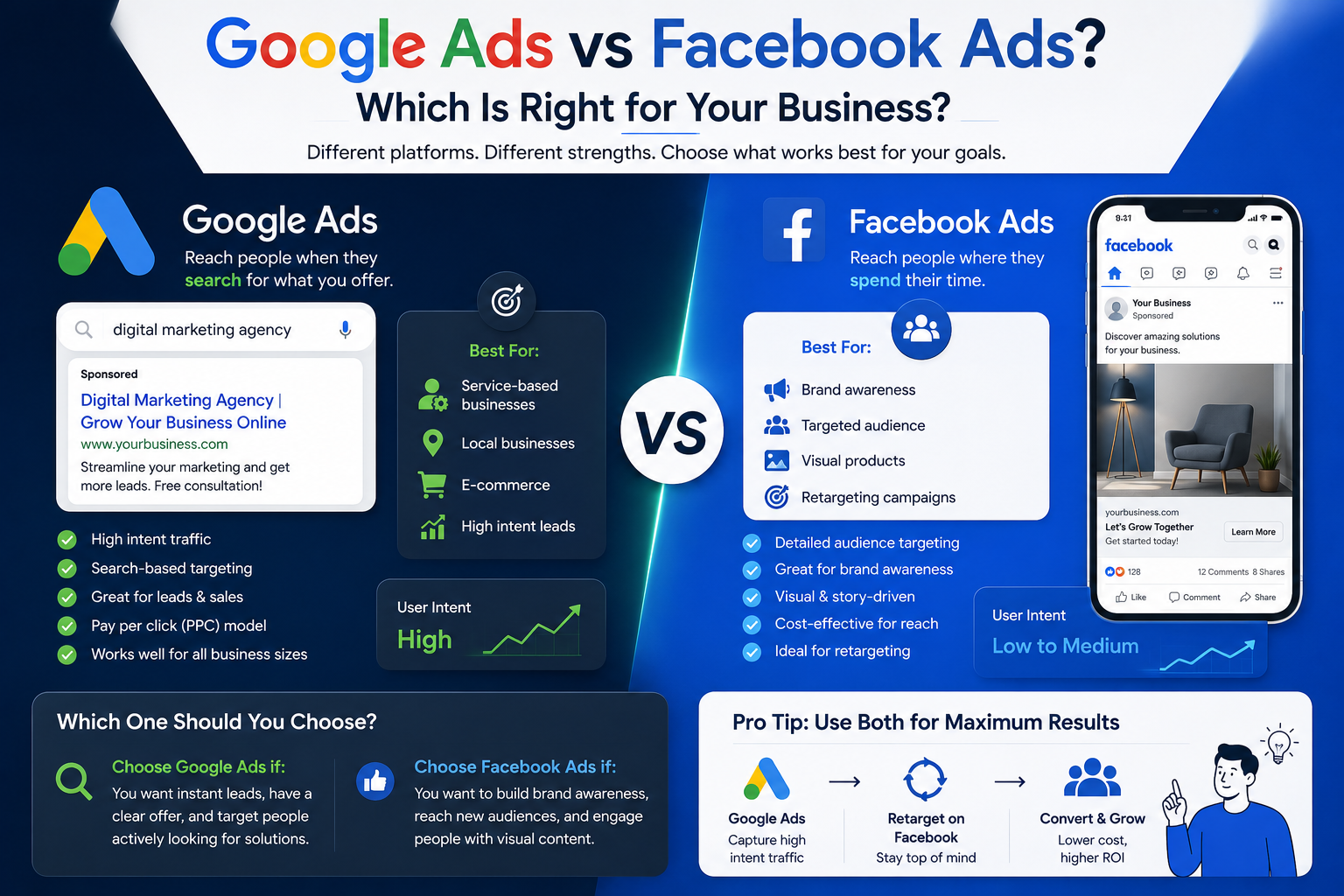
Google Ads targets people who are already searching for something. Someone types "best SEO agency in London" and your ad appears. They have intent they want something and they're actively looking for it.
Facebook Ads (now Meta Ads) work differently. You're not catching someone mid-search. Instead, you're putting your product or service in front of people while they're scrolling through their feed. You're creating discovery introducing your brand to people who didn't know they needed you yet.
This single distinction shapes everything else: the costs, the creative, the strategy, and the results.
How Google Ads Work
Google Ads is a search-first advertising platform. You bid on keywords, and your ads appear at the top of Google search results when someone searches for those terms.
The key strengths of Google Ads:
- High purchase intent: users are actively looking for a solution
- Massive reach: Google processes over 8.5 billion searches every day
- Multiple formats: search ads, display ads, shopping ads, YouTube ads
- Strong for local businesses: appear when someone searches "near me"
- Measurable ROI: track clicks, calls, form fills, and purchases directly
Google Ads Works Best for Existing Demand
Google Ads works best when people are already aware of the problem they need to solve. If someone searches "accounting software for startups," they know they need it you just need to show up with the right offer.
How Facebook Ads Work
Facebook Ads (Meta Ads) run across Facebook, Instagram, Messenger, and the Audience Network. Instead of targeting by search terms, you target by who people are their age, location, interests, behaviours, and more.
The key strengths of Facebook Ads:
- Laser-sharp audience targeting: reach very specific demographics and interest groups
- Highly visual formats: images, videos, carousels, Stories, Reels
- Great for brand building: keep your business top of mind over time
- Lower cost per click: typically cheaper than Google for most industries
- Excellent for retargeting: re-engage people who visited your website but didn't convert
Facebook Ads Works Best for Discovery
Facebook Ads excels at introducing your brand to people who haven't heard of you yet and then nurturing them until they're ready to buy.
Google Ads vs Facebook Ads: Cost Comparison
One of the biggest questions in paid advertising for small business is always: which one is cheaper?
Here's the honest answer it depends on your industry and goals.
Google Ads average cost per click (CPC):
- Typically ranges from GBP1 to GBP10+ per click
- Competitive industries (legal, finance, SaaS) can hit GBP20-GBP50 per click
- Higher intent means higher cost but also higher conversion rates
Facebook Ads average CPC:
- Generally ranges from GBP0.30 to GBP2.00 per click
- Lower entry cost makes it accessible for smaller budgets
- But lower intent means you often need more touches before someone converts
Cost Comparison Takeaway
So Facebook is usually cheaper per click. But Google clicks often convert faster because the user already wants what you're offering. When comparing Google Ads vs Facebook Ads cost for small business, don't just look at CPC look at cost per lead and cost per customer.
Which Platform Gives Better ROI?
This is the question every founder and marketer wants answered. And the honest truth is: it depends on what you're selling and where your customer is in their journey.
Google Ads tends to deliver better ROI when:
- Your product or service has clear, searchable demand
- You're selling high-intent purchases (e.g. software, legal services, home repairs)
- You want fast results from people ready to buy now
Facebook Ads tends to deliver better ROI when:
- You're building brand awareness in a new market
- Your product needs to be seen and explained visually
- You're targeting a specific niche audience with detailed interests
- You're running retargeting campaigns to warm audiences
Google Ads vs Meta Ads Performance
For Google Ads vs Meta Ads performance, the real winner is determined by your funnel stage. Google wins at the bottom of the funnel (ready to buy). Facebook wins at the top and middle (awareness and consideration).
Should Small Businesses Use Google or Facebook Ads?
For paid advertising for small business, budget matters enormously. Here's a simple way to think about it:
Choose Google Ads if:
- People are actively searching for what you offer
- You have a clear, specific service (e.g. "web development for startups")
- You want leads quickly and can handle a higher CPC
- You're in a local market where search intent is strong
Choose Facebook Ads if:
- Your product needs visual storytelling to sell
- You're targeting a very specific audience by interest or behaviour
- You're working with a limited budget and need volume of impressions
- You're building a brand and playing a longer game
Choose both if:
- You have the budget to test multiple channels
- You want to use Google to capture demand and Facebook to create it
- You're running retargeting - using Facebook to follow up with people who clicked your Google Ads
Google Ads vs Facebook Ads: Quick Comparison
| Category | Google Ads | Facebook Ads |
|---|---|---|
| Best for | High-intent buyers | Awareness & discovery |
| Targeting | Keywords & search terms | Demographics & interests |
| Average CPC | GBP1-GBP50+ | GBP0.30-GBP2 |
| Ad formats | Text, display, shopping | Image, video, carousel |
| Speed to results | Fast | Slower (needs nurturing) |
| Budget requirement | Higher | Lower |
| Best funnel stage | Bottom (ready to buy) | Top & middle |
Conclusion
There's no single winner in the Google Ads vs Facebook Ads for business debate. They're different tools built for different jobs.
If your customers are searching for what you offer, Google Ads gets you in front of them at the exact right moment. If you need to build awareness, tell a visual story, or reach a very specific audience, Facebook Ads is your platform.
The smartest businesses don't choose one or the other they use both strategically, at the right stage of the customer journey, to maximise every pound of their ad spend.
Start with the platform that matches your goals. Test, measure, and scale what works. That's how you turn paid advertising into a genuine growth engine.
Frequently Asked Questions
Are Google Ads better than Facebook Ads?
Neither is universally better they serve different purposes. Google Ads is better for capturing existing demand. Facebook Ads is better for creating demand and building awareness. The best choice depends on your product, audience, and goals.
Which ads are cheaper Google or Facebook?
Facebook Ads generally have a lower cost per click. However, Google Ads often deliver a higher conversion rate because users have stronger purchase intent. Always compare cost per lead, not just cost per click.
Which platform gives better ROI?
For businesses with searchable demand (e.g. services, software, local businesses), Google Ads often delivers stronger direct ROI. For brand-building, niche targeting, or visually-driven products, Facebook Ads can outperform. Many businesses get the best ROI by running both platforms together.
Should small businesses use Google Ads or Facebook Ads?
Start with the platform that best matches where your customers are. If people search for your service, start with Google. If your audience is defined by specific interests or demographics, start with Facebook. With a tight budget, test one platform first, measure your results, then expand.
Can you run both Google and Facebook Ads together?
Yes, and it's often the smartest move. Use Google Ads to capture people actively searching for your solution, and Facebook Ads to build brand awareness and retarget visitors who didn't convert. Together they cover the full customer journey.

Elevix Digital
Elevix Digital helps businesses build stronger websites, SEO systems, SaaS platforms, and digital marketing foundations for measurable growth.
View all postsNot Sure Which Ad Platform Is Right for Your Business?
At Elevix Digital, we help startups, founders, and growing businesses build paid advertising strategies that actually deliver results without wasting budget on the wrong channels. Whether you need Google Ads management, Facebook Ads campaigns, or a full-funnel paid strategy, we've got you covered. Our services include: Google Ads & PPC Management Facebook & Instagram Ad Campaigns SEO & Content Marketing Web Development & Landing Pages SaaS & Startup Growth Marketing Marketing Automation & CRM Integration. Ready to run ads that actually convert? Book a free strategy call with Elevix Digital today.