
Introduction
Growing a SaaS business is exciting until you realize that building the product was the easy part. Getting a consistent stream of qualified leads? That's where most SaaS founders hit a wall.
You can have the best software in the world, but if the right people aren't finding it, trying it, and subscribing to it, your growth stalls. Lead generation for SaaS companies isn't just a marketing task it's the engine that keeps your entire business moving.
In this guide, you'll learn what SaaS lead generation actually looks like in 2025, which channels work best, how to build a SaaS sales funnel that converts, and the strategies that separate fast-growing SaaS companies from the ones stuck at zero growth.
What Is Lead Generation for SaaS Companies?
Lead generation is the process of attracting potential customers people who are likely to benefit from your software and guiding them toward becoming paying users.
For SaaS companies specifically, a "lead" is usually someone who has shown interest in your product. That might mean they:
- Signed up for a free trial
- Downloaded a lead magnet (guide, checklist, template)
- Booked a demo call
- Subscribed to your email list
- Engaged with your content consistently
Lead Quality Matters More Than Contact Volume
The goal isn't just to collect contact information. It's to attract the right people those who actually have the problem your software solves.
This is where SaaS lead generation differs from traditional lead gen. You're not selling a one-time product. You're building a long-term relationship with a subscriber. That means every touchpoint - from a blog post to a free trial email sequence has to build trust and demonstrate value.
SaaS Lead Generation vs Demand Generation: What's the Difference?
This is a question that trips up a lot of SaaS founders.
Demand generation is about creating awareness and interest in your product category. It's top-of-funnel. Think: blog content, social media, podcasts, YouTube videos. It builds your brand and educates the market.
Lead generation is about capturing that interest and turning it into an actionable contact - someone you can nurture toward a purchase. Think: free trials, demo requests, content upgrades, and email sign-ups.
You need both. Demand gen fills the top of your funnel. Lead gen converts that attention into pipeline.
The most successful SaaS growth strategies run both simultaneously.
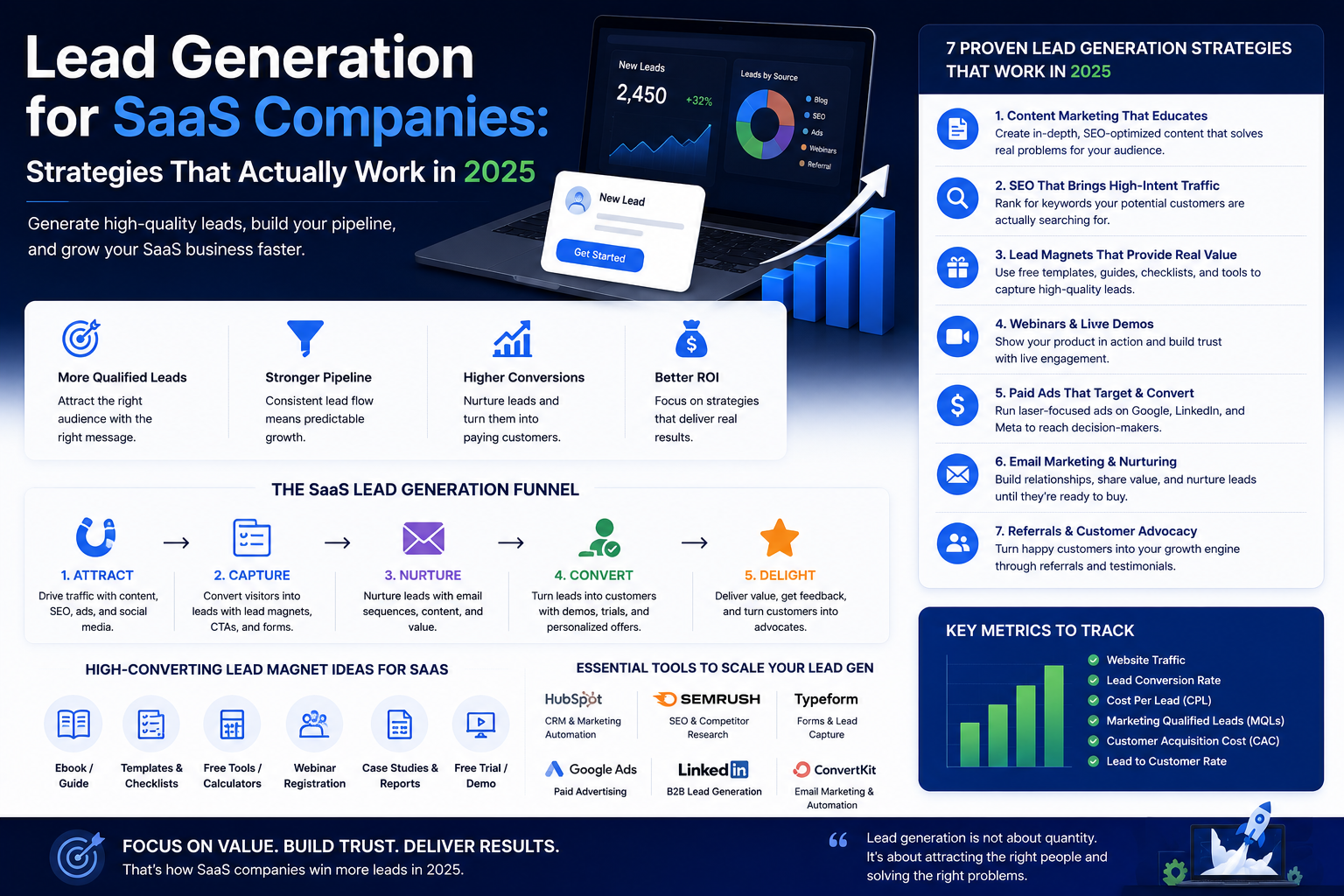
How Does a SaaS Sales Funnel Work?
Your SaaS sales funnel is the journey a potential customer takes from first hearing about you to becoming a paying and ideally loyal user.
Here's how a typical SaaS sales funnel for lead generation looks:
- Awareness - The prospect discovers you through a Google search, social post, referral, or ad.
- Interest - They visit your website and engage with your content, landing page, or free resource.
- Consideration - They sign up for a free trial, request a demo, or download a lead magnet.
- Evaluation - They test your product, receive onboarding emails, and measure its value.
- Decision - They convert to a paid plan (or churn which is data you can learn from).
- Retention & Referral - Happy customers stick around and refer others, lowering your customer acquisition cost over time.
Every Funnel Stage Needs Strategy
Every stage of this funnel requires deliberate strategy. Most SaaS companies focus too much on awareness and not enough on conversion - and that's where leads are lost.
The Best Channels for SaaS Lead Generation in 2025
There's no single magic channel. The best SaaS marketing strategy combines multiple touchpoints working together. Here are the channels that consistently deliver results.
1. Content Marketing and SEO
Long-form, search-optimized content is one of the most cost-effective channels for B2B SaaS lead generation. When someone searches "best project management software for remote teams" and finds your blog - that's a warm lead arriving at your door without paid ads.
What to create:
- Problem-focused blog posts targeting high-intent keywords
- Comparison pages ("Your product vs Competitor")
- Use case and industry-specific landing pages
- Tutorial content that showcases your product's value
SEO Compounds Over Time
SEO takes time, but the compounding effect is unmatched. A single blog post can generate leads for years.
Want SEO that actually drives SaaS leads? Talk to Elevix Digital we build content strategies that rank and convert.
2. Free Trials and Freemium
The most powerful lead generation tool in any SaaS company's arsenal is the product itself.
A well-designed free trial or freemium model lets prospects experience your value before paying. Done right, it removes the biggest barrier to conversion: trust.
Keys to making it work:
- Reduce friction in the sign-up process (fewer form fields = more sign-ups)
- Deliver value within the first session (the "aha moment")
- Use automated email sequences to guide trial users toward activation
- Set a clear, time-limited trial period to create urgency
3. Email Marketing and Nurture Sequences
Email remains one of the highest-ROI channels in SaaS marketing. Once someone enters your funnel - through a trial, demo, or lead magnet email is how you build the relationship that converts them.
High-performing SaaS email sequences include:
- Welcome and onboarding emails (first 7 days)
- Feature spotlight emails (show value progressively)
- Social proof emails (case studies, testimonials)
- Upgrade nudge emails (when trial is ending)
- Re-engagement campaigns (win back inactive users)
Automation Makes Email Scalable
Automation makes this scalable. You write the sequence once, and it runs for every lead automatically.
5. Partnerships and Integrations
One underused SaaS growth strategy is partnering with complementary tools. If your SaaS integrates with Slack, HubSpot, or Shopify, being listed in their marketplaces exposes you to thousands of qualified users who are already buyers.
Co-marketing with adjacent SaaS companies joint webinars, newsletter swaps, bundled offers - is another powerful way to reach warm audiences without large ad spend.
6. Product-Led Growth (PLG)
Product-led growth means your product itself drives acquisition, conversion, and expansion. Think Dropbox's viral sharing model or Calendly's embedded scheduling link.
If your product naturally creates shareable moments or benefits from network effects, build those referral loops intentionally. Every existing user becomes a channel for new lead generation.
SaaS Marketing Strategy for Startups: Where to Start
If you're early-stage and don't have the budget to run every channel at once, here's a focused starting point:
- Nail your ICP (Ideal Customer Profile): Know exactly who you're building for before spending a dollar on marketing
- Build one SEO-driven content pillar: Pick your highest-intent keyword and create the best piece of content on that topic
- Launch a free trial with an onboarding email sequence: Convert traffic into trials, trials into activations
- Add one paid channel: Google Ads or LinkedIn, depending on your audience
- Track and iterate: Measure conversion rates at every funnel stage and improve one step at a time
Consistency Beats Complexity
Consistency beats complexity every time. A simple funnel that works beats a complicated one that doesn't.
How to Scale SaaS Growth Beyond the First 100 Customers
Once you've found what works, scaling is about doubling down on your best channels, adding automation, and reducing churn simultaneously.
Scaling levers for SaaS growth:
- Invest in customer success to reduce churn and increase LTV
- Build an affiliate or referral program to turn customers into marketers
- Expand to new market segments with targeted landing pages
- Hire or partner for paid acquisition once your unit economics are proven
- Layer in account-based marketing (ABM) for high-value B2B targets
Scaling SaaS With Elevix Digital
Thinking about scaling your SaaS? Book a free growth strategy call with Elevix Digital we help SaaS startups build the systems and marketing engines to grow faster.
Conclusion: Build a Lead Generation Engine, Not Just a Campaign
The biggest mistake SaaS companies make is treating lead generation as a one-time campaign rather than an ongoing system.
The best SaaS businesses build engines repeatable, scalable processes that consistently attract the right people, guide them through a thoughtful funnel, and convert them into loyal customers.
Start with the fundamentals: know your ideal customer, create content they search for, offer a compelling free trial, nurture with email, and measure everything. Then layer in more channels as you grow.
Lead generation isn't magic. It's a system. And once yours is working, everything else - revenue, retention, referrals starts to compound.
Frequently Asked Questions
What is lead generation for SaaS companies?
SaaS lead generation is the process of attracting potential customers who are likely to benefit from your software and guiding them through a funnel from awareness to free trial to paid subscription. Unlike traditional lead gen, SaaS leads are typically nurtured through automated email sequences, onboarding flows, and product experiences.
How does SaaS lead generation work?
It works by combining multiple channels SEO content, paid ads, free trials, email nurturing, and referrals - to attract the right people, capture their contact information or product sign-up, and then systematically build enough trust and demonstrated value to convert them into paying customers.
What is B2B SaaS marketing?
B2B SaaS marketing refers to the strategies and tactics used to market software products to other businesses (rather than individual consumers). It typically involves longer sales cycles, multiple decision-makers, and content-heavy nurture strategies. Common channels include LinkedIn, SEO, email marketing, webinars, and account-based marketing.
What is the best channel for SaaS lead generation?
There's no single best channel it depends on your audience, budget, and stage of growth. That said, SEO-driven content marketing and free trial funnels consistently deliver the best long-term ROI for most SaaS companies. Paid ads work well for faster results, while referral programs and PLG are powerful at scale.
What's the difference between SaaS lead generation and demand generation?
Demand generation creates awareness and market interest it builds your brand and educates potential buyers. Lead generation captures that interest by turning visitors into identifiable contacts you can nurture. Both are essential: demand gen fills your funnel, lead gen converts it.

Elevix Digital
Elevix Digital helps businesses build stronger websites, SEO systems, SaaS platforms, and digital marketing foundations for measurable growth.
View all postsReady to Build a Lead Generation System for Your SaaS?
At Elevix Digital, we help SaaS startups and growing businesses build the full stack they need to generate leads and grow from a high-converting website to SEO content strategy, marketing automation, and custom SaaS development. What we can help you with: SaaS development and MVP launch, SEO and content strategy that drives qualified traffic, marketing automation to nurture leads on autopilot, conversion-optimized landing pages and web design, and end-to-end digital marketing for SaaS growth. Don't let a leaky funnel or missing strategy slow your growth down. Book a Free SaaS Growth Strategy Call with Elevix Digital: Let's map out your lead generation system together.